
The Rise and Fall of Samuel Doe: A Story of Power and Betrayal
THE STORY OF... is a recurring feature that takes readers beyond headlines and public
perception, offering richly detailed portraits of well-known individuals. Each article in the series
will explore the journeys, challenges, influences, and lesser-known moments that shaped
someone famous—revealing the person behind the fame.
THE STORY OF Samuel Doe
“Do unto others as you would have them do unto you”
Born in rural Liberia, Samuel Kanyon Doe rose from modest roots to lead his country. His story
reveals how someone outside the elite can seize control — and how absolute control can lead to
ruin. In what follows, I will explore his childhood, his path to dominating the state, what
governance looked like under him, how his authority unravelled, and the terrible end he met.
Early life and brief background
Samuel Kanyon Doe was born on May 6, 1951, in Tuzon, a secluded village located in Grand
Gedeh County in southeastern Liberia. He was a member of the Krahn ethnic group, part of the
numerous indigenous communities whose lives were influenced by a system led by the
descendants of freed African Americans. Doe’s family worked as subsistence rice farmers, and
their financial struggles reflected the situation of many in rural Liberia who had limited access to
education, political authority, or economic opportunities. In this environment, young Samuel’s
future prospects were limited, although the social dynamics surrounding him were significant
and impactful.
His education started in his village, where he finished primary school by the age of sixteen. He
then went to a Baptist junior high school in Zwedru, the capital of the county, but due to
financial constraints and accessibility issues, he did not pursue traditional schooling any further.
By the mid-1960s, with limited resources and few opportunities, Doe left the conventional
school system. In search of a new path, he joined the Armed Forces of Liberia around 1969.
1
His choice to enlist in the military was partly driven by the hope of attaining educational
opportunities, such as earning his high school diploma through programs supported by the army;
although the plan he envisioned did not materialize exactly as expected, his time in the military
became the foundation for his rise.
As his military journey advanced, Doe exhibited skill and commitment. He underwent training in
Monrovia at the Communications School of the Ministry of Defense in 1971. Gradually, he was
assigned to different positions, including leadership roles in Monrovia, and earned a reputation
for his discipline, shooting accuracy, and dependability. By October 11, 1979, he attained the
rank of Master Sergeant and became the administrator of the Third Battalion in Monrovia, an
important role in a unit based in the capital city. Although he did not finish high school through
traditional means, Doe continued his education, studying through correspondence and attending
evening classes whenever he could.
After Tubman's death in 1971, his vice president, William Tolbert, assumed leadership. Tolbert
aimed to encourage greater participation but also encountered accusations of favoritism,
nepotism, and mismanagement—issues that lingered among the indigenous majority.
By the end of the 1970s, tensions were escalating in Monrovia and across Liberia. Increasing
economic disparity, corruption, and limited options for political reform fueled dissatisfaction
among those who felt excluded from power. In 1979, a contentious proposal to raise the price of
rice—a staple food—sparked public demonstrations in Monrovia, which the government
responded to with force, resulting in numerous fatalities.
In a climate of irritation and disillusionment, military leaders like Doe, who were outside the
Americo-Liberian elite yet held roles within the government, were in a prime position to
capitalize on the situation. Doe’s origins—modest, indigenous, disciplined, yet marginalized—
provided him with credibility among many Liberians who felt alienated. By the time Doe gained
prominence in Monrovia’s military, Liberia was a fractured nation: officially independent, yet
2
limited by the historical legacy of racial hierarchy and elite dominance; economically
progressing, yet socially inequitable; politically stable on the surface, yet underlying tensions
simmered. In that intense environment, Doe’s rise was not just a personal narrative—it was a
response to years of systemic exclusion, racial division, and unrealized aspirations.
In the early 1980s, Liberia was experiencing significant unrest. For over a century, the country
had been ruled by the Americo-Liberian elite—descendants of freed slaves from the United
States—while indigenous Liberians, such as Samuel Doe from the Krahn ethnic group, felt
marginalized when it came to political, economic, and social influence. Though President
William R. Tolbert Jr., who had been in office since 1971, attempted some reforms, issues like
corruption, inequality, and ethnic discontent continued to escalate. A pivotal incident occurred
with the “rice riots” in early 1980: Tolbert's decision to raise the price of rice, a key food staple
sparked widespread protests. The government responded with force, leading many to view
Tolbert’s administration as disconnected and oppressive.
On April 12, 1980, Master Sergeant Samuel Doe, along with around seventeen other non-
commissioned officers and enlisted personnel from the Armed Forces of Liberia, executed a
premeditated military coup. This group mainly consisted of indigenous soldiers who felt
marginalized. In the early hours before dawn, they launched an attack on the executive mansion
in Monrovia, the residence of Tolbert. During this assault, President Tolbert was killed, and the
exact number of casualties remains a topic of debate. But in addition to Tolbert, about 26 others
– guards, personnel, close associates – died in the coup.
3
The coup occurred rapidly. After taking control of the executive branch, Doe and his associates
set about dismantling the existing power structures. He suspended the constitution, dissolved the
legislature, and disbanded the ruling True Whig Party, which had been the governing force in
Americo-Liberian politics for many years. Under Doe's leadership, a military regime was formed
under a group known as the People’s Redemption Council (PRC), which consisted of Doe and
several other junior officers. Doe took on the role of head of state and commander-in-chief of the
military.
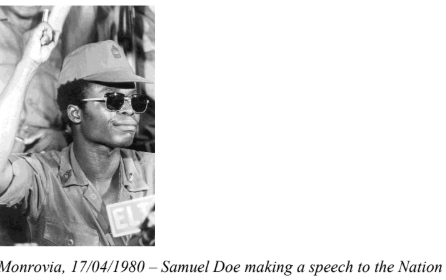
Monrovia, 17/04/1980 – Samuel Doe making a speech to the Nation
Shortly after the coup, Doe’s government executed high-ranking officials from Tolbert's
administration without trial. Thirteen ministers from Tolbert’s cabinet faced public execution,
many in particularly gruesome ways. For instance, ministers were said to have been publicly
displayed before being shot by firing squad on a beach. These executions functioned both as
symbolic gestures (to signify a departure from the previous regime) and as warnings to anyone
who might challenge the new authority.
Doe and the PRC also arrested numerous former officials of Tolbert, accusing them of offenses
like corruption, human rights abuses, and “high treason.” Some of those detained were not
formally charged, and legal processes were either minimal or entirely absent. Trials frequently
took place through military or PRC-appointed commissions. The government imposed martial
law and disregarded rights such as habeas corpus. Political dissent was stifled, as reported by
The Washington Post at the time. Ethnic dynamics were significant, with Doe, being Krahn,
appointing many of his fellow Krahn to influential positions within the military and government.
4
He was distrustful of, or marginalized, other ethnic groups due to concerns over potential
counter-coups or internal conspiracies. This preferential treatment intensified ethnic tensions in
Liberia.
Although Doe vowed to restore civilian governance, this was postponed. For years, the PRC
predominantly ruled through decrees. In 1984, a new constitution was established, partially
intended to create a facade of legitimacy, followed by an election in 1985 conducted under the
political party Doe established, the National Democratic Party of Liberia (NDPL). Doe contested
in this election for the presidency and was proclaimed the winner—though the election was
widely regarded as fraudulent. International monitors and opposition factions condemned the
procedure as manipulated, citing voter intimidation, manipulation, and a lack of transparency.
Doe was inaugurated as President in January 1986.
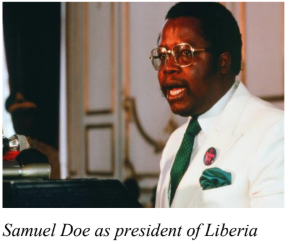
Samuel Doe as president of Liberia
During this time, there were also attempts to overthrow Doe. One prominent individual in the
early post-coup era of Liberia was Thomas Quiwonkpa, who had initially assisted Doe in the
1980 coup but later had a falling out with him. In November 1985, General Thomas Quiwonkpa
made an unsuccessful attempt to stage a coup. He entered Liberia from Sierra Leone with the
intent to take control of the government. However, the plot did not succeed. Quiwonkpa was
arrested, brutally mutilated, and killed by troops loyal to Doe. This led to retaliatory actions,
particularly in Nimba County, home to many members of the Gio and Mano ethnic groups.
While this solidified Doe’s hold on power, it also heightened opposition and resentment.
5
Doe's ascent to power involved aggressive military tactics, the suppression of existing elites, the
use of propaganda and fear, ethnic favoritism, and eventually the implementation of nominally
democratic processes to validate his rule. Many within the indigenous majority initially
supported the coup, seeing it as an end to years of exclusion; however, Doe’s governance
exhibited early signs of authoritarianism that would later drive Liberia towards civil war.
Like his predecessor, Doe did not change much. He showed favoritism toward individuals from
his own Krahn tribe. Members of the Krahn tribe received preferential treatment in government,
the military, and business, which bred resentment among other groups, particularly the Gio and
Mano tribes. Detractors, journalists, and critics faced arrest, beatings, and even death. There
were widespread massacres and serious human rights violations as documented by Human
Rights Watch.
A particularly infamous incident was the Monrovia Church massacre in July
1990, during which approximately 600 civilians seeking refuge in St. Peter’s Lutheran Church
were killed by government troops. Many of the victims belonged to the Gio and Mano tribes.
This occurred following a rebellion led by Charles Taylor, a former official under Doe who had
turned into an adversary. Taylor commanded the National Patriotic Front of Liberia (NPFL),
launching attacks from neighboring Côte d’Ivoire. The uprising originated in the Nimba County
area in the northeast, where many had suffered under Doe’s rule. Doe’s forces responded with
extreme violence. In Nimba and beyond, troops killed civilians, destroyed villages, and executed
reprisals against suspected supporters of the rebels, especially within the Gio and Mano
communities. The conflict rapidly escalated. Meanwhile, Prince Yormie Johnson’s Independent
National Patriotic Front of Liberia (INPFL), a faction that broke away from Charles Taylor’s
NPFL along with other rebel groups, advanced toward Monrovia, the capital.
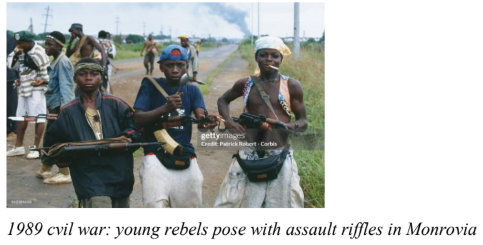
1989 cvil war: young rebels pose with assault riffles in Monrovia
6
The civil war plunged Liberia into turmoil: extensive human rights abuses, mass population
displacements (with over half the citizens becoming refugees or internally displaced), rampant
looting, sexual violence, and conflict from multiple factions. The environment was unstable.
While Doe attempted to retain control and hold onto power, his allies dwindled, resources
became scarce, and anxiety increased. The mounting pressure from rebel forces, internal
disagreements, dwindling international support, and the splintering of the government made his
downfall increasingly unavoidable.
CAPTURE AND DEATH OF SAMUEL DOE
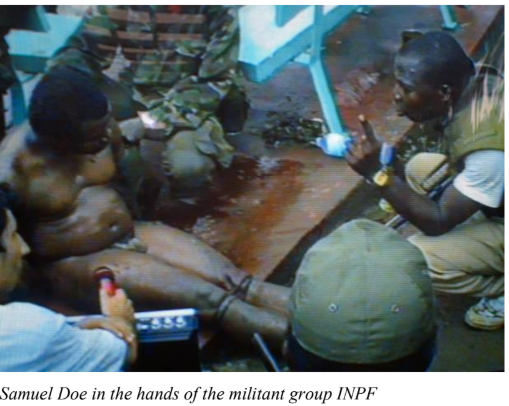
Samuel Doe in the hands of the militant group INPF
On September 9, 1990, as Doe left his secure refuge and approached the headquarters of
ECOMOG (a West African peacekeeping force) in Monrovia, , he was intercepted by Prince
Johnson’s INPFL troops and taken captive. This happened despite ECOMOG commanders
guaranteeing him safety. Following his capture, he endured horrific torture, mutilation, and
execution. Among the gruesome acts were the severing of body parts, burning, beating, and
mocking him. This ordeal was filmed and the footage circulated, shocking Liberia and the world.
7
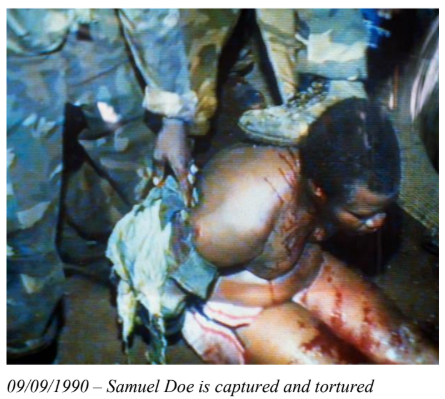
09/09/1990 – Samuel Doe is captured and tortured
Following his death, Prince Johnson proclaimed himself the leader of the state for several
months until an interim administration known as IGNU (Interim Government of National Unity)
was established, led by Amos Sawyer. However, Liberia had already plunged into an even
deeper state of conflict. The war persisted, with numerous factions battling, widespread human
suffering, and severe devastation. The location of Doe's body was never reliably established; the
fate of his remains continues to be uncertain.
A write up by Lughano Mwaghwegho
Photo acknowledgements: Naijah, Feanny/corbis via getty images
